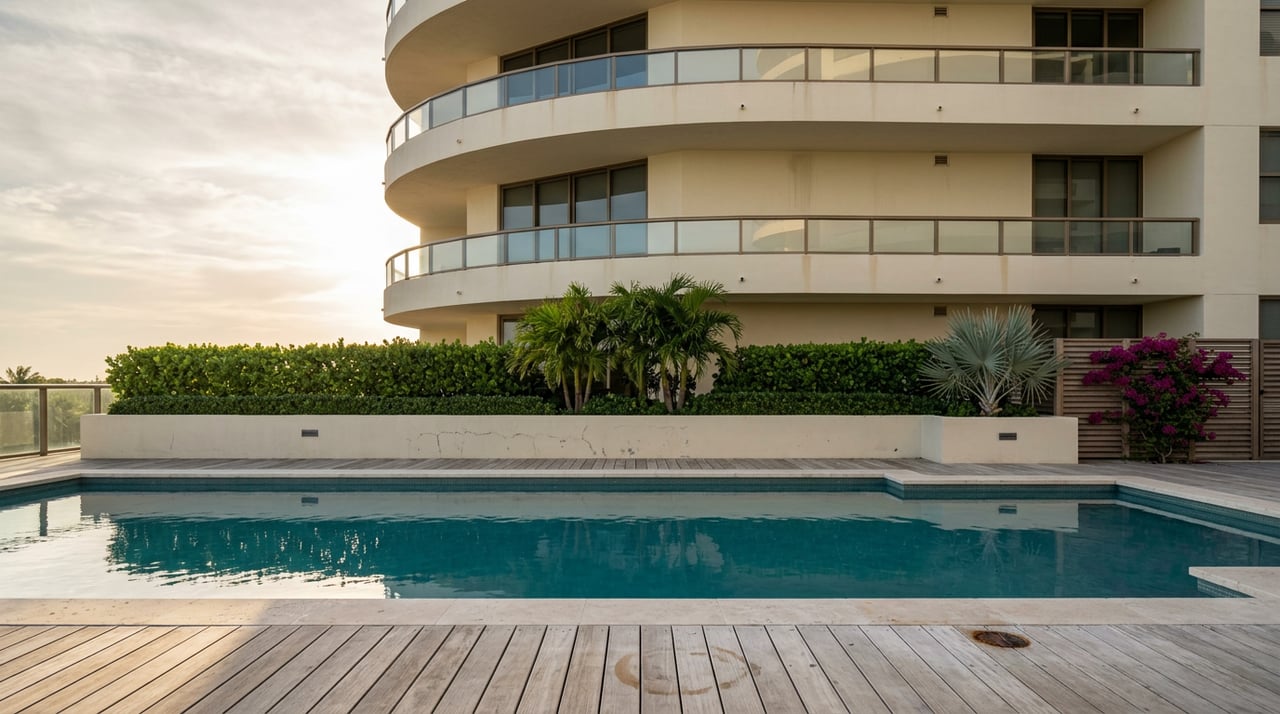
Owners at 1060 Brickell thought they had done everything right. The two-tower complex went up in the late 2000s, which by South Florida standards makes it practically new. No 1970s concrete. No decades of deferred salt-air corrosion. And yet in late 2024, residents were handed a $21 million special assessment for repairs to the Tower 2 facade, the roof, and the pool deck, with individual bills ranging from roughly $30,000 to $110,000 per unit depending on the source.
One resident, Nima Mahdjour, put it plainly to CBS News Miami:
"I think it's excessive. I feel like I'm being milked."
If you're shopping for a condo in Miami right now, that story should reorganize how you think about risk. Most buyers use a building's age as a rough proxy for assessment danger: older tower, more worry; newer tower, less worry. 1060 Brickell was 16 years old. According to Miami-Dade County, it hadn't come close to the 25-year coastal recertification threshold or the 30-year mark that triggers a state milestone inspection. None of that mattered. The board still found enough deferred maintenance to justify an eight-figure bill.
The Statutory Deadlines Are a Floor, Not a Ceiling
Florida's post-Surfside reforms get discussed as if they're the whole story on condo risk. They aren't. Senate Bill 4-D created the milestone inspection requirement for condo and co-op buildings three stories or taller once they hit 30 years old, or 25 if they sit within three miles of the coast. The companion Structural Integrity Reserve Study, or SIRS, forces associations to fund reserves for eight specific structural components: things like the roof, load-bearing walls, plumbing, and waterproofing. According to the Florida Department of Business and Professional Regulation, as of January 1, 2026, boards can no longer vote to waive or underfund those structural reserves, and any association that was under owner control on or before July 1, 2022 was supposed to have its first SIRS completed by December 31, 2025, with a December 31, 2026 outer deadline for buildings that coordinated their SIRS with a milestone inspection.
Those are real, binding dates, and they matter enormously for buildings old enough to be caught by them. But they are a legal minimum, not a description of when a building can develop a repair bill. Miami-Dade County has run its own 40-year recertification program since 1975, layered on top of the newer state rules, and that program exists precisely because the county's building department already understood that age thresholds are administrative triggers, not safety guarantees. A building can need real structural work well before any statute says it has to be inspected.
That's the mechanism buyers miss. The milestone and SIRS deadlines tell you when a building is legally required to look. They tell you nothing about what a board decides to fix voluntarily, how well it funded reserves in its first decade, or how a management company chooses to interpret "normal wear and tear" on a 16-year-old facade. At 1060 Brickell, one owner told NBC 6 that the engineering report he read didn't use the words "critical" or "life-threatening" at all, and yet the board moved forward with the assessment anyway. Whether that particular disagreement was resolved fairly is beside the point for a buyer evaluating a different building. The lesson transfers: assessment risk is a function of how an association manages money and maintenance, not a countdown clock you can read off the certificate of occupancy.
What This Means When the Market Is Giving You Room to Ask
Here's where the timing actually favors buyers. Miami-Dade's condo market has been split for a while now between older resale inventory and new luxury product, and as of June 2026, the data behind that split had widened further. The countywide median condo price fell 3.15 percent year over year to $431,000, months of supply sat at 12.3, comfortably in buyer's market territory against the usual 6 to 9 month balanced range, and active listings dropped 11.47 percent year over year to 11,550, the fifth straight monthly decline, even as prices kept softening. Days to close stretched from 71 to 111 over the same period. Meanwhile the beach luxury tier told a different story entirely: $5 million-plus condo sales in beach submarkets jumped 29.7 percent in the second quarter of 2026, and the average beach condo price rose 6 percent to $1.68 million.
Read those two data sets together and the picture sharpens. The softness is concentrated in older, resale-heavy inventory, exactly the buildings most likely to be carrying reserve funding gaps or approaching a milestone deadline. That's also exactly the inventory where sellers have the least leverage right now. A buyer looking at a vintage tower in this market isn't just negotiating on price. Slower absorption and rising days on market give you real standing to ask for what the building's paperwork actually says before you commit, and to put conditions on the table if the answers are thin.
What to Actually Request Before You Write an Offer
Florida Statute 718.503 already gives you the right to ask for two specific things: the inspector-prepared summary of the milestone inspection report, if one exists, and the association's most recent SIRS, or a written statement that no SIRS has been completed. Use that right, but don't stop there. A fuller diligence request, regardless of the building's age, should include:
- The milestone inspection report and certificate.
- The SIRS itself, not just a summary, showing the funding percentage against what the study says the association should have on hand. A reserve fund sitting at 20 to 30 percent of target is carrying a deferred liability that has to be made up somehow, through higher dues, a special assessment, or an association loan.
- The last two annual budgets and reserve schedules, so you can see whether funding has been trending toward compliance or away from it.
- Two years of board meeting minutes, where assessment votes, reserve transfers, and waiver discussions actually get recorded. This is where a building like 1060 Brickell would have shown its hand well before the $21 million number became public.
- Current insurance declarations, including wind and flood coverage, since a SIRS that flags water intrusion or corrosion can push master insurance premiums up independent of any assessment.
If an association can't produce a completed SIRS when asked, that's worth treating seriously; a missing or vague answer tells you something about how the building is run even if you can't quantify the risk yet. You're also entitled to a seven-day rescission period after receiving an association's financial disclosures, which is a real legal window, not a courtesy the seller is extending you.
The Financing Angle Nobody Mentions First
There's a second reason to run this diligence before you fall in love with a unit: it affects whether you can finance it at all. More than 1,400 Florida condo buildings were sitting on Fannie Mae's restricted list earlier this year, meaning conventional financing wasn't available and buyers had to fall back on portfolio loans, non-QM products, or jumbo financing at less favorable terms. Buildings land on that list for reasons that track directly with everything above: an incomplete milestone inspection, SIRS non-compliance, reserves below minimum funding thresholds, inadequate master insurance, or a pending special assessment material enough to affect the project's finances. A building that looks perfectly fine on a walkthrough can still be a financing headache if its paperwork isn't in order, which is one more reason the documents matter more than the finishes.
A Few Questions Worth Asking Before You Tour
Does a newer building mean I can skip this diligence? No. 1060 Brickell is the clearest counterexample available right now: 16 years old, nowhere near a statutory recertification trigger, and still facing a $21 million bill. Age tells you when the law requires a look. It doesn't tell you what a board decided to fix on its own timeline.
What if the seller says there's no pending assessment, but the paperwork is old? Ask why. A budget without the latest amendments, or an engineering summary that predates the last two years of board minutes, can give you an incomplete picture even when nobody is being deliberately misleading. Request a dated document index and note what's missing.
Does this apply the same way to a building I'm considering buying into for the first time versus one I'm selling? The documents are the same either way, but sellers in today's vintage-inventory market have more reason to have this paperwork ready before listing. A clean, well-funded association is a selling point worth presenting up front rather than defending after an offer comes in.
The 1060 Brickell story isn't a reason to avoid Brickell, or condos generally, or buildings under twenty years old. It's a reason to ask the same five questions no matter what the building looks like from the lobby. If you're weighing a Miami condo purchase or getting ready to sell one, Marilu Perez-Perez can walk you through exactly which documents to request from a specific building and how to read what they say before you're the one signing at closing.
This article is general information, not legal, tax or financial advice. Consult a qualified professional about your situation.